Automate fish embryo workflows for quality and control
For zebrafish, killifish and similar models, our AI-powered sorters bring automation to research using fish models —screening and selecting fish embryos with speed, precision, and care. Supporting New Alternative Methodologies (NAMs) worldwide.
Automate your embryo workflows with clarity and control
Whether you’re advancing developmental biology or scaling tox assays, Bionomous helps you screen, sort, and plate fish eggs and larvae with precision—saving time, reducing variability, and improving outcomes.
Screen more embryos, faster
Handle thousands of embryos per hour with up to 95–99% accuracy—supporting both lab-scale experiments and industrial environments.
Improve fish embryo selection quality
Detect larvae malformations, unfertilized eggs, or fluorescent marker expression using bright-field and fluorescence imaging—so only good embryos move forward.
Reduce manual labor and errors
Automate one of the most tedious steps in aquatic biology—freeing up researchers and technicians to focus on analysis, not sorting.
Simplify fish embryo workflows
in aquatic research
The EggSorter and Sortivo bring automation to aquatic biology by sorting fish eggs and larvae with speed, accuracy, and minimal disruption. From screening developmental stages to isolating fluorescent markers, it gives you reliable results—every time.
Automate aquatic toxicology workflows
Easily sort embryos by stage and viability to prepare for exposure studies—standardizing early endpoints and improving reproducibility in toxicology assays.
Enhance genetic line selection
Use fluorescence-based sorting to isolate transgenic or reporter-line embryos with high accuracy—reducing false positives and saving downstream effort.
Reduce stress and embryo loss
Gentle handling and low-shear movement preserve embryo viability while removing damaged or unfertilized embryos.
Build your own embryo sorting criteria—no code required
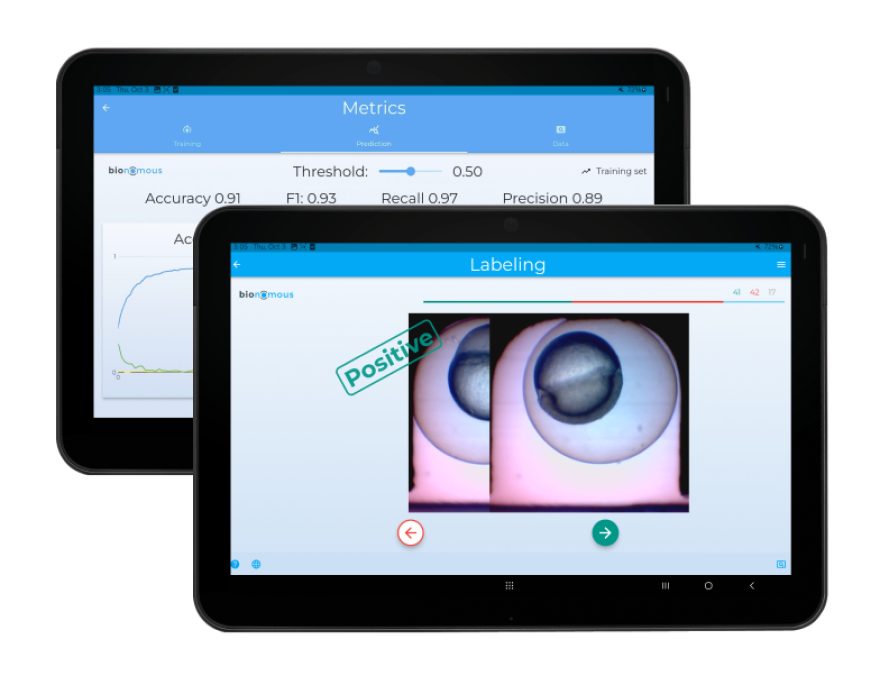
LabSwipe lets you define what “viable” means for your application. Whether you’re isolating embryos with transgenic markers or optimizing egg quality, you can create and apply custom AI models with just a few swipes.
Train for species-specific traits
Each species has unique features. Use LabSwipe to annotate images and teach the sorter to recognize embryo traits in zebrafish, medaka, killifish, or similar models.
Customize sorting protocols
Design your own grading logic for morphology, size, or stage. Ideal for different research projects and husbandry protocols.
Update models as needs evolve
Update your model as protocols or production cycles evolve. LabSwipe lets you update and retrain AI models instantly—so you stay in control.
Verena Zimermann, zebrafish and the Jazwinska Group
New year, new beginning! That is particularly true for Verena Zimmermann, who retired in December 2024 from her role as a laboratory technician at the Jazwinska Group (University of Fribourg…
In the USA, January is characterized by creativity. In fact, the creativity month celebrates outside-the-box-thinking, the expression of ourselves and the innovations. To match with this idea, we decided to…
Single and ready to mingle: zebrafish mating protocols
Zebrafish are social fish, used in research notably for their ability to produce large numbers of offspring. At the end of this month under the sign of love, we are…
Discover how we’ve evolved our technology to automate zebrafish larvae handling. Screen, sort, and plate larvae in brightfield and fluorescence — all in one platform.
What are the differences between EggSorter and Sortivo for fish embryo applications?
The two platforms cover complementary stages of the fish workflow, from egg to larva.
EggSorter — for eggs (0 hpf to hatching, 0.5 to 2 mm). High-throughput sorting of uniform entities on a rotary wheel. Best for husbandry, fertilisation checks, stage selection and routine egg sorting in zebrafish, killifish and medaka.
Sortivo — for larvae(2 to 7 dpf, up to 5–6 mm). Image-based sorting of complex entities with 360° (not available in US) brightfield and multi-channel fluorescence imaging, AI classification and gentle continuous-flow handling. Best for transgenic line screening, xenograft and PDX screening, and toxicology assays including FET / OECD 236.
Which species can Bionomous sorters handle?
Zebrafish (Danio rerio)
Killifish (Nothobranchius furzeri)
Medaka (Oryzias latipes)
What sample sizes are supported?
EggSorter: The device works with entities sized 500 µm to 2 mm. To ensure consistent sorting, the batch should have a homogeneity of ±100 µm.
Sortivo: The device works with entities sized 300 µm to 2 mm, including heterogeneous size batches.
How fast is the EggSorter?
Processes up to 1 entity every 0.5 seconds (depending on mode, up to 5 sec/entity).
On average:
50 embryos in a Petri dish → 2–3 minutes
96-well plate → 3–5 minutes
What screening modes are available?
Brightfield imaging (transmitted and reflected light).
Fluorescence screening with up to 6 filter cubes, including: BFP, GFP, YFP, tdTomato, mCherry A, mCherry C. Full specifications available upon request.
360º screening (not available in the US).
What is the dispensing volume?
The minimum dispensing dose is 50 µL per sample, with a precision of ±10%.
What output containers are supported?
The EggSorter is flexible and can dispense into:
Falcon tubes (up to 2)
Multiwell plates (6x to 96x wells, up to 4 plates)
Petri dishes (up to 4 × 10 cm)
Is embryo viability affected?
No. Studies show that embryos remain healthy after processing with the EggSorter:
Our platforms can be cleaned with 70% ethanol or 5–10% bleach, ensuring safe and easy maintenance.
What are the devices dimensions?
EggSorter:
50 × 50 × 30 cm (L × W × H)
Weight: ~18 kg
Sortivo:
72 x 48 x 50 cm (L × W × H)
Weight: ~30 kg
Hear about our impact in labs like yours
At the Leibniz Institute on Aging – Fritz Lipmann Institute (FLI), we are using the EggSorter for sorting Nothobranchius furzeri wild type eggs onto plates containing coconut substrate. The EggSorter has proven to be a highly reliable and efficient tool in our workflow, significantly streamlining the egg-sorting process.
We are very satisfied with its performance. The system operates with very high precision and consistency, helping us to save time and standardize a previously labor-intensive step. The EggSorter fully meets our expectations and has become an indispensable part of our daily work with N. furzeri embryos
— Beate Hoppe, Facility Manager, Leibniz Institute on Aging – Fritz Lipmann Institute (FLI)
Our goal was to robotize the sorting of the fish eggs to improve our productivity. We acknowledge the perseverance of Bionomous to solve technical difficulties and successfully deliver the tool adapted to our specific needs. The eggsorter dedicated to Medaka fish eggs facilitates the work of our technicians.
The Bionomous EggSorter saves me valuable time in the laboratory while ensuring accurate and reliable results. Thanks to its automation, I can focus on my experiments/other tasks without worrying about repetitive sorting tasks.
Page Lab | Louvain Institute of Biomolecular Science and Technology (LIBST)
The Bionomous EggSorter has streamlined our zebrafish workflow by automating tedious manual tasks and saving us valuable time. Its efficiency makes it an ideal tool for modern zebrafish research and breeding programs.
Zebrafish Core Facility | Centre for Comparative Medicine Research (CCMR), University of Hong Kong
The EggSorter system has been evaluated in technical trials for the classification of sea bream and bluefin tuna eggs, showing potential to support the assessment of spawning quality in research contexts. It may also have applications in commercial marine hatcheries, particularly if further improvements in processing speed continue to be implemented.
Aurelio Ortega, Head of Aquaculture Department | Spanish Institute of Oceanography (IEO - CSIC)